Platform · Consumption

Containerized network architecture: isolated, portable, upgradable

Every Hermes service runs as an isolated container. Upgrade one function in place, scale another independently, and never take the whole system down for a patch

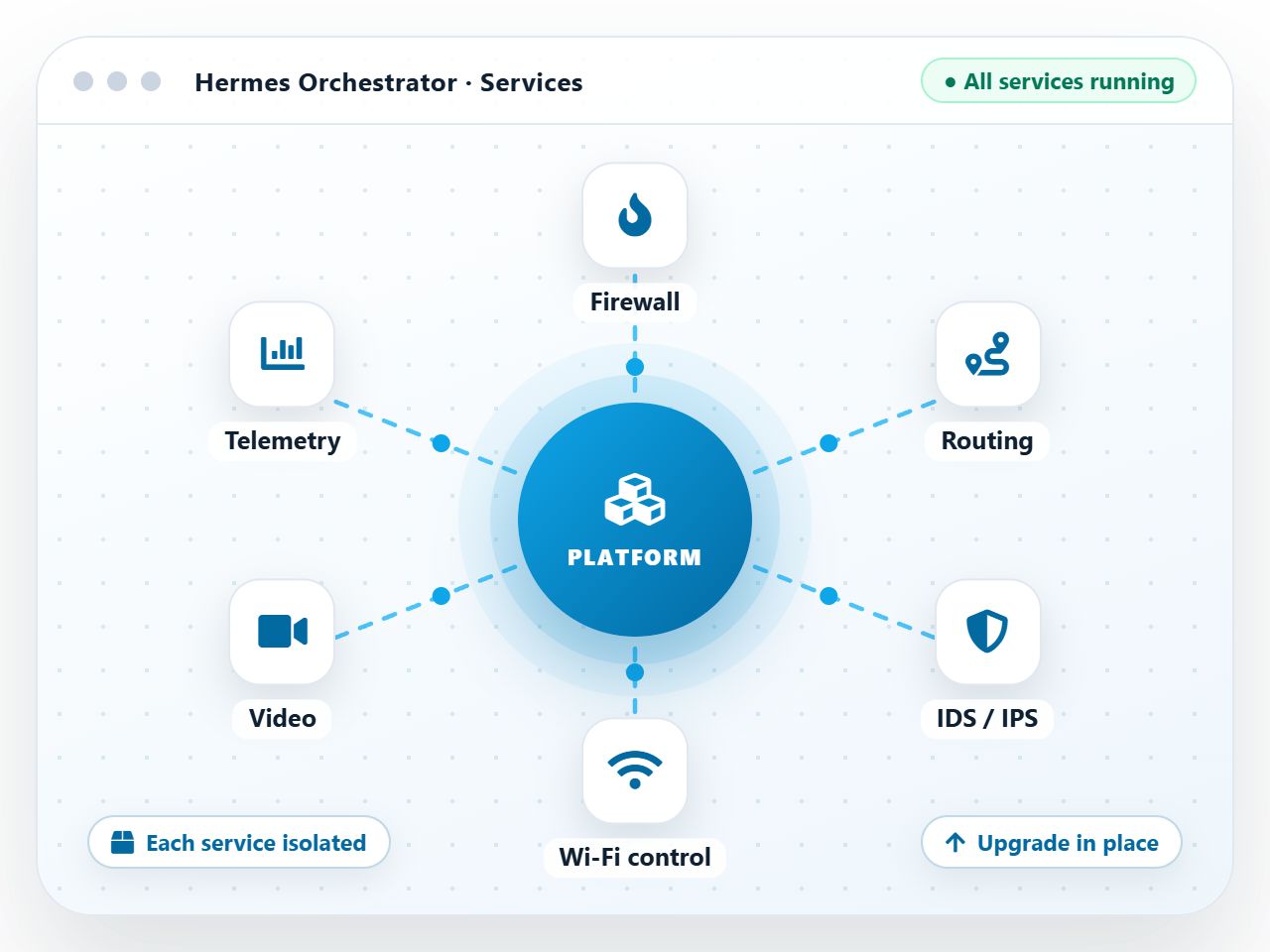
Hermes diagram: containerized architecture
Why it matters

Why the architecture matters

Traditional network appliances run every function in one monolithic image. A bug in one feature can take down the whole box, and a security patch for one service means upgrading, and often rebooting, everything at once.

Hermes runs each service, such as routing, firewalling, IDS/IPS and telemetry, as its own isolated container. A fault in one service cannot cascade into the rest, a single function can be upgraded in place, and each service gets exactly the resources it needs. The same services run in our cloud, your cloud or at the edge.

At a glance
A fault in one service stays contained
Upgrade one service with no fleet-wide downtime
Same services in the cloud or at the edge
Each function scaled independently
Capabilities

Built from isolated services

Containers make the platform safer to run and faster to improve

Service isolation

A fault in one service can’t cascade into the rest.

Upgrade in place

Roll a new version of one service with no fleet-wide downtime.

Portable by design

Run in our cloud, your cloud or at the edge, with the same services.

Independent scaling

Give each function exactly the resources it needs.

Security services

Firewalling, IDS/IPS and threat intelligence each run as their own service.

Tested before release

Validate changes in the Digital Twin before they reach production.

How it works

How an update rolls out

1

Build

A new version of one service is packaged as a container.

2

Test

Validate the change in the Digital Twin first.

3

Roll out

Upgrade that service in place across the fleet.

4

Run

Every other service keeps running, untouched.

FAQ

Containerized architecture FAQ

Can’t find your answer? Our solutions architects are happy to help

Each part of the platform runs as its own isolated software container instead of one monolithic image. Containers can be updated, restarted and scaled independently.

Isolation means a fault in one service cannot take down the others, and updates can be applied to one function without disrupting the whole system.

A single service can be upgraded in place without fleet-wide downtime, while the rest of the platform keeps running.

The same containerized services can run in the Hermes cloud, in your cloud, or at the edge.

Changes can be validated in the Hermes Digital Twin before they are rolled out to production.

See it on your network

Book a working session with a Hermes solutions architect —
we’ll model your sites in a Digital Twin first.